
By Leigh Anne Darlene E. Dispo
Atty. Romar Bae Montesa, known among his friends as “Boss Romar,” is a School of Law graduate of San Beda College Alabang last 2024 and currently a practicing lawyer at the Public Attorney’s Office (PAO), committed to helping society transform by consciously making daily decisions as a lawyer that benefit the needy and the marginalized.
“Before entering law school, I was motivated to pursue the legal profession primarily to fulfill my father’s aspiration of becoming a lawyer, a dream which he was unable to realize during his lifetime,” Atty. Montesa started. It is no secret that most lawyers today initially ventured into the pursuit of the law merely out of vicarious fulfillment. When a parent’s unrealized ambitions become a filial piety, the almost unconscious payoff is a life lived through one’s child. And through Atty. Montesa, perhaps it is a life being lived meaningfully. When his father passed away in 2021, Atty. Montesa experienced grief in what he described as a “profound sense of loss.”
But it did not deter him from keeping the motivation to continue a legal career. “As I was a Philosophy major, I thought that my learning experience would be confined to studying philosophical and ethical standpoints,” he said. “To me, it appears the classroom setting espouses an intangible form of education, where I cannot fully comprehend the existing social and material conditions of our time.”
When asked what inspired him to become a lawyer at PAO, he shared about participating in university programs and community activities that exposed him to the realities faced by marginalized sectors and the indigenous: “I was nakedly exposed to the issues of landlessness, blatant displacement, and violation of basic rights. It transformed the way I understood the law and social responsibility.” He continued, “I realized that legal knowledge should not remain purely theoretical; it should be used as a tool to protect people’s rights and advance social justice. The law should not only serve those who have the actual means to access it [but also those who are] vulnerable and weak.”
Indeed, having previously engaged in private practice, Atty. Montesa personally observed that clients who can afford legal services get to have their interests and needs represented accordingly. In PAO, however, the disparity is palpable. Although the lawyering aspect still involves the pretense of safeguarding the claims of his clients, being part of PAO meant one cannot render service for personal gain. “It is out of a duty to ensure that those who cannot afford private legal representation are still afforded access to justice, especially when the most vulnerable sectors have no one else to turn to for protection and assistance,” he said.
It begs the question, then, of what makes being a lawyer an ambitious profession beyond the grueling dedication and prolonged physical and mental fatigue it takes. For Atty. Montesa, it is the aspiration to become a good lawyer. He said, “My end goal is to become one who faithfully upholds justice, gives every person what is rightfully due to them, and remains steadfast in the ethical responsibilities demanded by the profession.”
“For me, the practice of law is not defined merely by obtaining the title of attorney, but by the constant and conscious choice to act with integrity, pursue justice, and honor the duty owed to both the law and the people,” he added.
Yet, the common (mis)conception among law students is that “good lawyers” are only those who are not afraid to deep their feet in activism. But Atty. Montesa disagrees: “People’s lawyering is neither essentially limited to public practice nor to legal practice in non-governmental organizations (NGOs) or quick response legal teams (QRTs).”
Broaching the subject of the recently established Unified Legal Aid Service (ULAS), he maintains that it is a legal aid service “specially streamlined for conducting proper and adequate legal assistance to individuals who cannot actually afford it.” In its issuance, the Supreme Court (SC) developed such a people-oriented program where members of the legal profession are required to render a designated number of hours of legal aid and legal consultation services. By engaging with legal aid programs such as ULAS, lawyers have actual avenues to revisit their genuine commitment to protecting basic people’s rights. “Bakit ako nagsimula? Binabalikan ko ‘yan. S’yempre, para sa masa,” Atty. Montesa confessed.
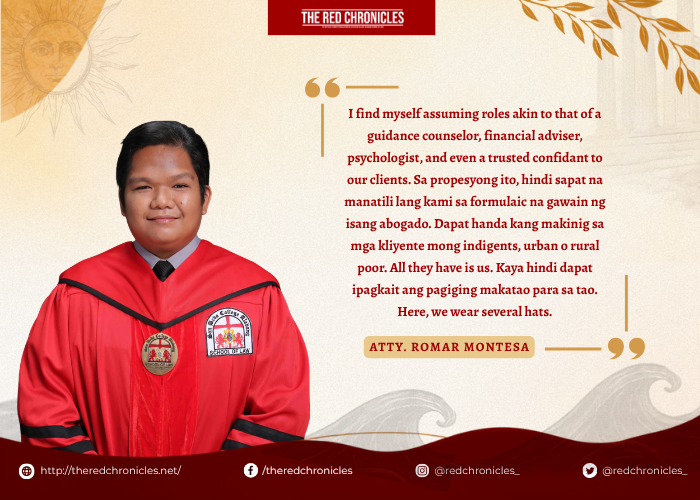
When asked if he has had any deviations in his profession as a lawyer, he said: “I find myself assuming roles akin to that of a guidance counselor, financial adviser, psychologist, and even a trusted confidant to our clients.” For Atty. Montesa though, these are all to be expected. “Sa propesyong ito, hindi sapat na manatili lang kami sa formulaic na gawain ng isang abogado. Dapat handa kang makinig sa mga kliyente mong indigents, urban o rural poor. All they have is us. Kaya hindi dapat ipagkait ang pagiging makatao para sa tao. Here, we wear several hats,” he said.
For most law students, the practice of law is not simply the fulfillment of a childhood dream inherited from his father, nor is it merely the attainment of a professional title. It is a continuing commitment to serve those who often find themselves unheard, unrepresented, and overlooked. From the classrooms of philosophy to the frontlines of public legal service, Atty. Montesa’ journey reflects a belief that the law finds its highest purpose when it becomes accessible to the people who need it most.
In a profession often defined by expertise and advocacy, he reminds us that effective lawyering also requires empathy, patience, and humanity. Whether acting as counsel, adviser, listener, or confidant, he embraces the many roles demanded by public service with the understanding that justice is not achieved through legal knowledge alone, but through genuine concern for the lives behind every case. In wearing several hats, he demonstrates that the measure of a lawyer is not only in the arguments made before the court, but also in the willingness to stand with the people the law is meant to protect.
