
By Aaron Gabriel R. Gomez
Nearly two months have passed since the political landscape of a small, landlocked country surrounded by the Himalayas, yet a shroud of precariousness looms over the “Roof of the World.” Fueled by mass frustration and clamors for transparent governance, the nation of Nepal lingers in a political limbo — one that heavily determines its future as a state.
As the South Asian nation had just undergone a forceful and radical change in its chambers of government, its citizenry was left at a crossroads. Swaths of uncertainty have been the common thought within its younger demographic, and slow pacing in terms of democratic processes further continues to simmer tensions. And as young Nepalese citizens had bravely stood up against the tides of corruption and inequality, most are now left dumbfounded as the resulting bloodshed, destruction, and fragility now silhouettes over their nation.
An unstoppable force
What started out as simple dissatisfaction on social media had been the catalyst for how members of Nepal’s ‘Gen Z’ protesters carried out national regime change. Expressing discontent and utter disgust for how the children of the country’s elite, colloquially known as ‘nepo kids’, citizens have taken to the sphere of networks such as Facebook and Instagram, to highlight their frustrations with how most of the country’s next generation is bereft of economic opportunities, while its miniscule portion continues to flaunt exorbitant riches and glamor online. In response, the Government of Nepal had ordered the shutdown of multiple social media outlets, many of which millions of the Nepalese people depended on. According to independent media Peoples Dispatch, this initiative meant cutting off either lines of communication, conducting micro-to-small enterprise affairs, or receiving remittances.
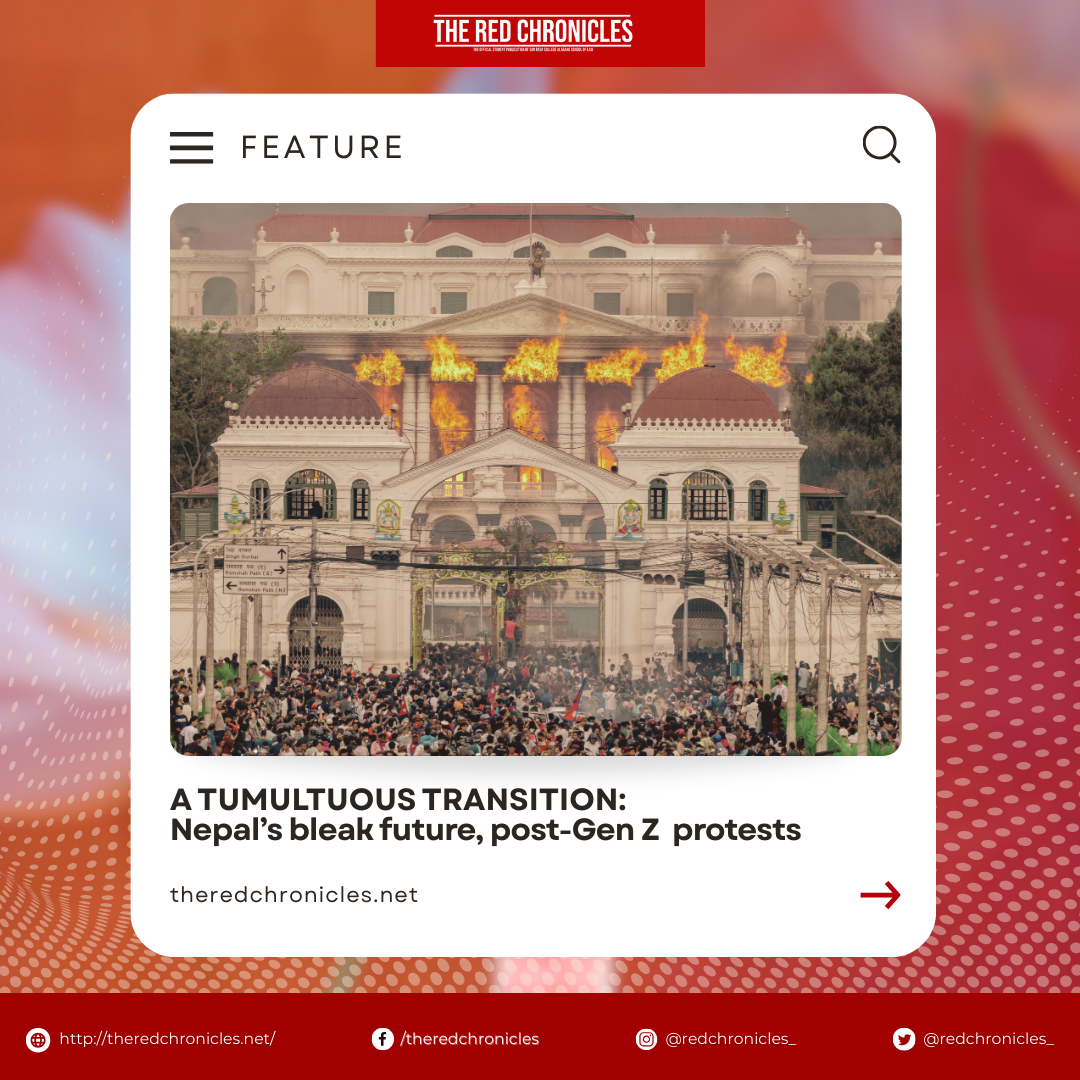
In the eyes of the Nepalese, these measures meant forced silence. The removal of socioeconomic opportunities. A totality of their already fragile sense of sovereignty. With the state enacting a crackdown on dissenters, the mob of the student-led youth upped the ante; public escalation increased, with youth movements — spearheaded by Hami Nepal — using digital channels such as Instagram and Discord to coordinate movements and protests. Escalations reached a boiling point when on September 8, Nepalese security forces, encumbered with massive waves of angry students, started using violence as a means of crowd control.
From using rubber bullets, water cannons, and tear gas, to the unjustified use of assault rifles, at least 19 people were killed and more than 347 citizens have been injured as a result of the protests. Former Nepalese Prime Minister K. P. Sharma Oli had resigned the next day on September 9th amid widespread public distrust in his capability as the country’s top executive.
A South Asian Spring
These waves of youthful dissent have spread throughout neighboring regions as well. Indonesia had recently gone through large-scale civil unrest over widespread economic upheaval among its citizens, as well as insensitive government policies favoring politicians in terms of housing priorities. What soon followed were rampaging mobs that set fire to several government buildings through the cities of Jakarta, Makassar, and Surabaya — a real-life testament of sovereignty on full display.
The Philippines is no stranger to these mass demonstrations. The recent Trillion Peso March served as a series of mass protests held last September 21 in response to widespread reports of anomalies throughout the Philippines’ flood control infrastructure project system. Church groups, political coalitions, student-led organizations, labor unions, and regular Filipino citizens alike had taken to several places throughout Manila in peaceful calls for change, amid widespread corruption that had resulted in improper and lacking flood infrastructure throughout the country.
All of these protests are aimed at a singular objective in mind: calls for accountability, and more transparent and better governance. Although, several differences can be identified with how each country’s citizenry has used its sovereignty; while nations such as Indonesia and Nepal have been more radical and focused in enacting change, going so far as to conduct violent measures to achieve a desired outcome, demonstrations within the Philippines have been more lenient and ‘peaceful’, which in the eyes of cynics, can be understood as ‘weak’ — both politically and legally unmotivated.
Kathmandu, post-protests
The streets of Kathmandu and throughout Nepal have simmered into a low calm throughout the course of the protests. On September 12, through a mass online discussion on the virtual chat room Discord, protesters held an interim election on who to vote as the next Nepalese prime minister, with former Supreme Court Chief Justice Sushila Karki taking the reins as the next head of government in the country. Karki, who is favored among members of the country’s youth, was selected for her transparent and progressive views — ideals seemingly on the edge, months after the protests had ended.
Elections in Nepal are scheduled for March 2026, with socialist, constitutional monarchist, and social democratic political parties all vying for a seat of power in holding an already unstable region in the Himalayas. And with this towering notion of an unending power struggle for Kathmandu, multiple members of young Nepalese citizens have expressed either anger or anxiety with the uncertainty for the nation’s future. An exclusive by the New York Times has revealed that significant members of the country’s Gen Z had simply wanted reform in their country, instead of the violent and bloody revolution that changed the fabric of their nation’s history. And with the elections creeping near, a vibrant future seems bleak for the country whose economic background is perforated by nepotism, graft, and corruption.
Striking similarities
While Nepal and the Philippines are thousands of kilometers away from each other, both nations share a similar background wherein patronage politics and systemic corruption have long been ails of their legal and political systems. The Philippines alone had to unravel a deep-seeded tumor during the infamous Priority Development Assistance Fund, commonly known as PDAF or the Pork Barrel Scam, leading to hundreds of thousands of Filipinos venting their frustrations at Luneta — all in the hopes of delivering those who were complicit in the scheme to justice. This sense of frustration was channeled into the halls of the Supreme Court through Concepcion v. Sandiganbayan (G.R. No. 247677, October 11, 2021), when the petitioner was caught as the primary supervisor of how the disbursement of funds was channeled from several government-owned and controlled corporations (GOCCs) to fictitious non-governmental organizations (NGOs).
However, a key difference in both the countries’ approach to highlighting massive corruption is through the response of the executive amid massive distrust. While Nepal’s prime minister was forced to resign, the Philippine President Ferdinand “Bongbong” Marcos, Jr. remains steadfast in his supposed goals of bringing the perpetrators of these flood control projects to justice.
In a purely legal perspective, it can be argued that the Philippines’ head of state is merely fulfilling his executive power to the best of his abilities; while laymen may argue that it is very easy for the country’s Commander-in-Chief to simply vindicate the perpetrators behind these irregularities in government spending, the doctrine of the separation of powers withdraws the president from merely countermanding every choice made by the legislative or judicial department, unless otherwise provided by law. It is within the very tenets of the Constitution — and its framers — to ensure that in times of civil wariness, the government upholds its duty to secure the sovereignty of the State, as provided within Article II, Section 3 of the 1987 Constitution. With this in mind, a key tenet for any aspiring legal practitioner is to never misconstrue the construction of the law. While assumptions weigh heavily on hearts and minds, it is important to practice the proper application of jurisprudence; not every decision made relies on the idea of expressio unius est exclusio alterius.
Elections in Nepal are slowly nearing, yet its young demographic holds precariousness in their choices. For some, the revolution symbolized success — the epitome of civilian authority. While for others, a bleak feeling of somber notions holds anxiety for the future of their country.
The Philippines could learn a thing or two from what recently happened in Nepal, hence it also begs the question: Are Filipinos actually ready to face the bitter fact that forced change does not end at ‘peaceful’ protests?
References:
Chandra, Atul, and Pramesh Pokharel. 2025. “Nepal’s Gen-Z Uprising Is About Jobs, Dignity – and a Broken Development Model.” People’s Dispatch, September 9, 2025. https://peoplesdispatch.org/2025/09/09/nepals-gen-z-uprising-is-about-jobs-dignity-and-a-broken-development-model/.
G.R. No. 247677: “Belina A. Concepcion v. Sandiganbayan.” 2022. Supreme Court E-Library. November 16, 2022. https://elibrary.judiciary.gov.ph/thebookshelf/showdocs/1/68204.
Tunac, Hermes Joy. 2025. “Over 200 sectoral, church groups to rally vs corruption on September 21.” GMA Integrated News, September 21, 2025. https://www.gmanetwork.com/news/topstories/nation/959168/september-21-rally-edsa-luneta/story/.
Wong, Edward. 2025. “Nepal’s Gen Z Revolution.” The New York Times, October 8, 2025. https://www.nytimes.com/2025/10/08/world/asia/nepal-gen-z-revolution.html?utm_campaign=likeshopme&utm_content=ig-nytimes&utm_medium=instagram&utm_source=dash+hudson.
