
By: Alyssa Marie L. Reyes
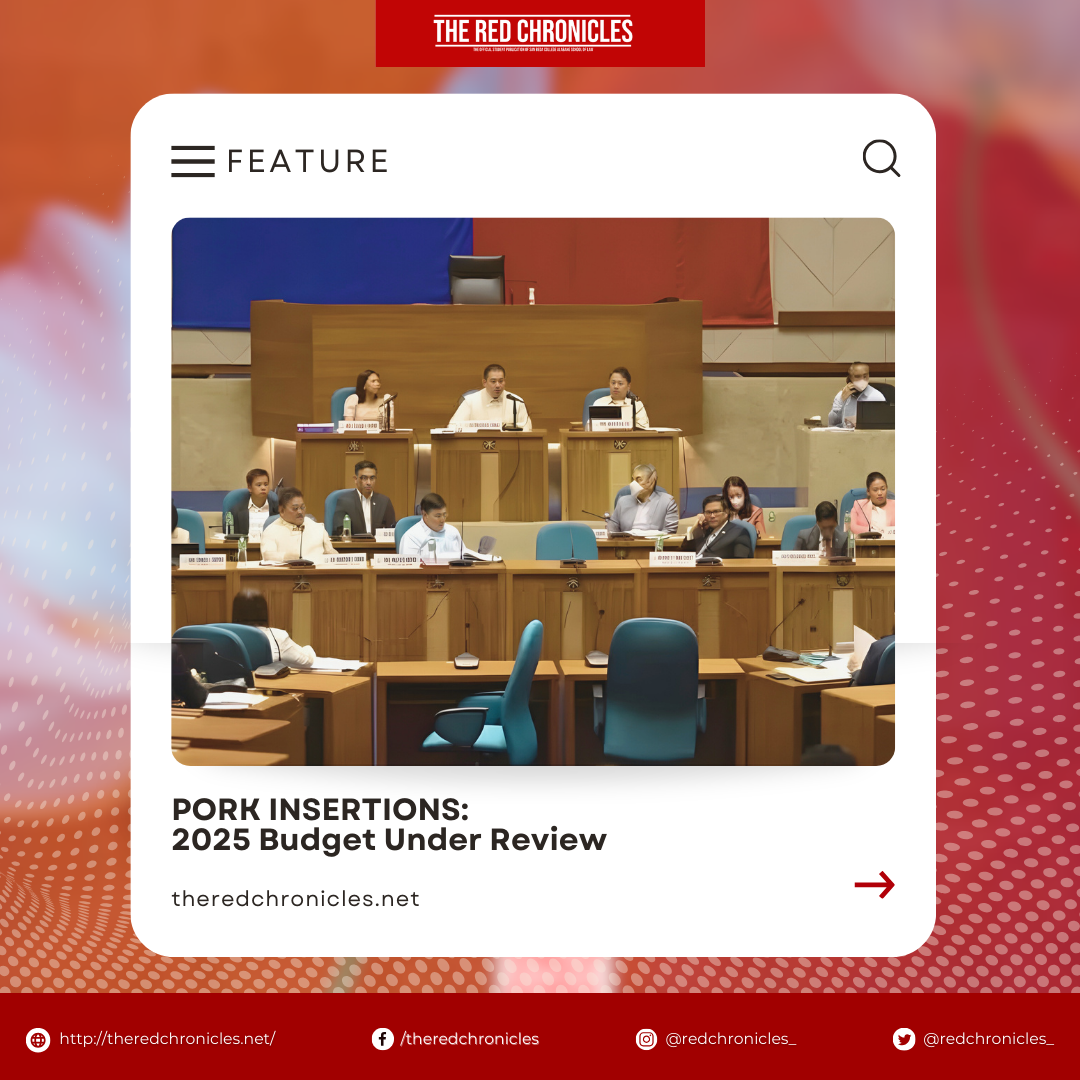
Senator Panfilo Lacson reported that almost all senators in the 19th Congress allegedly made individual budget insertions amounting to at least Php 100 billion in the 2025 General Appropriations Act (GAA). These allocations were reportedly distributed across major agencies such as the Department of Public Works and Highways (DPWH), Department of Education (DepEd), and Department of Transportation (DOTr). Some items were marked “for later release,” raising concerns on whether these funds had been properly reviewed or were intended for discretionary use by legislators. Lacson warned that these insertions may mirror the pork barrel system declared unconstitutional in Belgica v. Ochoa, which prohibited legislators from exercising post-enactment control over public funds. This signals a deeper problem.
When transparency disappears, public trust vanishes as well, and the biggest casualty is genuine public welfare. Citizens deserve to know that resources meant for development are protected.
THE BUDGET APPROPRIATION PROCESS
I. BUDGET PREPARATION (EXECUTIVE BRANCH)
Under the 1987 Constitution, the Department of Budget and Management (DBM) prepares the National Expenditure Program (NEP), which the President must submit to Congress within 30 days from the opening of its regular session, as provided in Article VII Section 22.
II. BUDGET LEGISLATION (LEGISLATIVE BRANCH)
The House of Representatives initiates and approves the General Appropriations Bill (GAB), after which the Senate conducts its own review and introduces amendments. A Bicameral Conference Committee then reconciles the differences between the two versions to produce the final GAA.
III. BUDGET EXECUTION (EXECUTIVE BRANCH)
Once enacted, the President may exercise the power of line-item veto and, through the DBM, implement the budget. The Commission on Audit (COA) ensures that all public funds are disbursed in accordance with law and sound fiscal management. This process, mandated in our Constitution, protects and safeguards the rights of citizens. Any deviation or grave abuse of discretion violates these rights. Citizens entrust their elected officials with the duty to protect and uphold these rights.
Article VI, Section 25 (5) of the 1987 Constitution prohibits the transfer of appropriations, except to allow the President, the Senate President, the Speaker of the House, the Chief Justice, and the heads of Constitutional Commissions to use savings to augment items in their respective budgets. This provision reinforces the doctrine of separation of powers, whereby Congress enacts appropriations and the Executive implements them. Once the GAA is enacted, legislators have no authority to participate in its execution. When this boundary is blurred, it not only compromises the constitutional framework but also diminishes the public’s confidence in the impartiality of decision-making and the fair allocation of resources.
This constitutional rule was strengthened in Belgica v. Ochoa, where the Supreme Court struck down the Priority Development Assistance Fund (PDAF) for granting legislators post-enactment authority over funds. Similarly, in Araullo v. Aquino III, the Court invalidated portions of the Disbursement Acceleration Program (DAP) for transferring savings to projects not authorized by the GAA. These rulings affirmed that the legislature’s power over appropriations ends upon the law’s enactment. These landmark cases show that our rights are protected. There is still hope in pursuing justice to ensure that fiscal integrity and public trust are upheld.
VALIDITY OF BUDGET INSERTIONS
I. AMENDMENTS
Congress may validly amend the NEP during deliberations if such amendments are collectively approved, itemized, and clearly reflected in the final GAA. These institutional amendments are legitimate exercises of the legislative power of appropriation.
II. INVALID INSERTIONS
However, individual insertions where lawmakers identify projects or influence the release of funds after enactment are unconstitutional. Allocations marked “for later release” or inserted without sufficient documentation amount to post-enactment intervention, violating the separation of powers and reflecting the discretionary system invalidated in Belgica.
CONTROVERSIES AND IMPLICATIONS
Transparency shows that our rights are not prejudiced, assuring citizens that every peso allocated and every project funded is duly and faithfully executed, and designated for public welfare.
The Php 100 billion budget insertions raise serious concerns about transparency, fiscal discipline, and accountability. The lack of disclosure regarding individual amendments undermines the people’s right to information on government spending, as recognized in Valmonte v. Belmonte, Jr. Citizens must be assured that public funds are used for their intended purpose and for public welfare. Such acts may divert funds from essential, development-oriented programs, weaken fiscal discipline, and erode public trust in government institutions. The continued presence of “pork-like” allocations also runs counter to the reform measures initiated after Belgica and Araullo. These issues have renewed calls for greater openness in the budget process. Advocates urge the creation of digital monitoring systems by the DBM and COA to track fund releases in real time, as well as the full disclosure and stricter vetting of locally funded projects. This is a call for honesty and accountability in public finance, ensuring that citizens’ rights are respected and that public resources serve the public good.
The controversy surrounding senators’ budget insertions reflects the ongoing challenge of balancing legislative discretion with constitutional restraint. While Congress exercises the power of the purse, this authority must be carried out collectively, transparently, and within constitutional limits. Individual or post enactment participation by legislators in fund allocation violates the principles of separation of powers and public accountability. Upholding fiscal discipline and transparency is essential to ensure that the GAA remains an instrument of national development and genuine public service, rather than political influence. Knowing all these constitutional mandates that protect our rights, how will you uphold justice and protect your rights in your own personal capacity?
