
By Angel Kate Alag
Layout by: Lou Margaret S. Nebit
“A privilege, not a right.” Jurisprudence defines the practice of law as something that few have the chance to do. Law school is a battleground, not just of intellect but of perseverance, grip on thy dreams, and a hope for a better system.
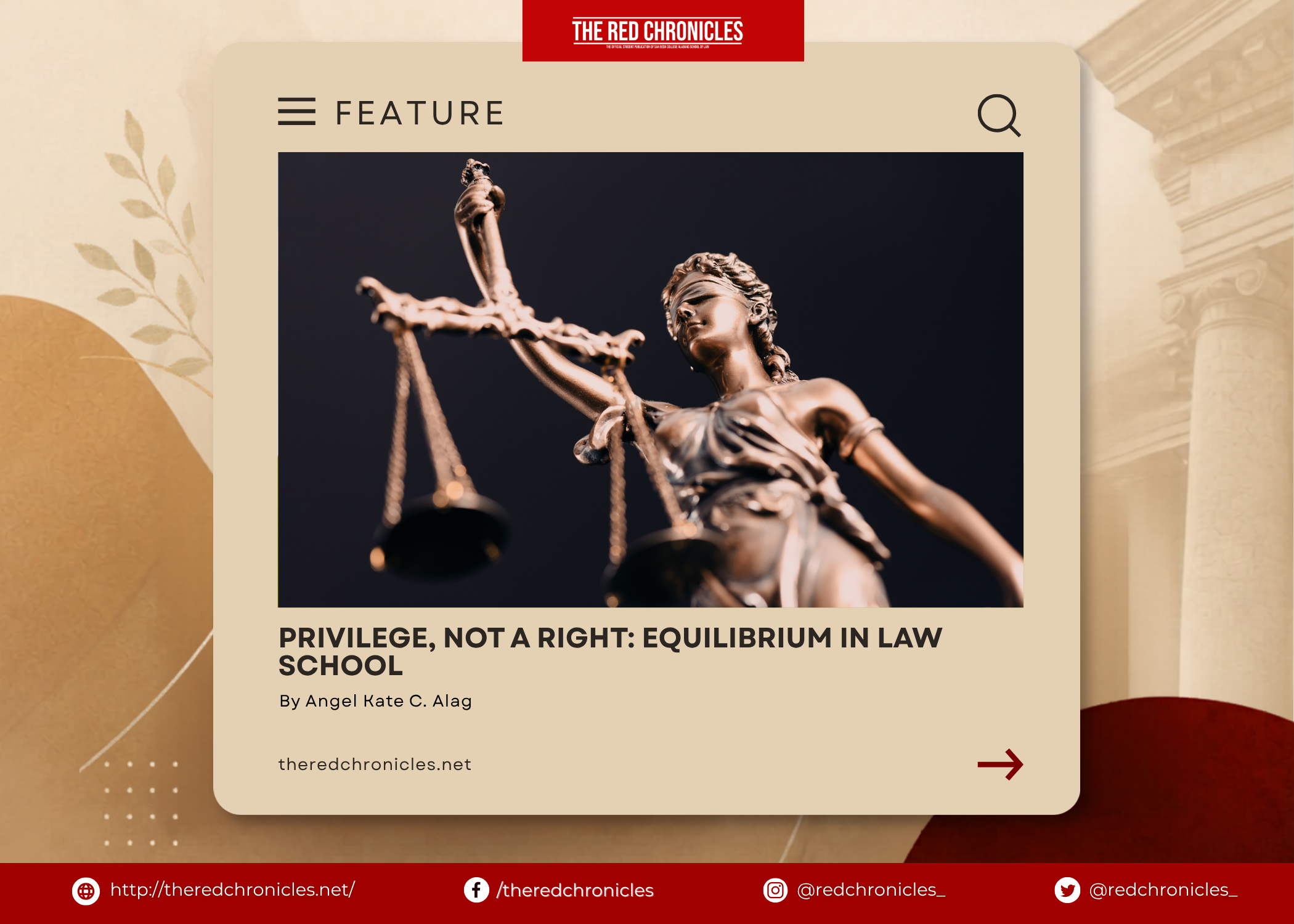
Equilibrium is the definition of law.
What does equality really mean? In society, we often favor the indigents because they need more. Hence, we forget that justice is not only for the impoverished but also for all people in the community. Just because you are well-off in life does not mean you should receive less, and being indigent does not give someone leeway to enrich themselves unjustly. And yes, it may be hard to swallow, but dura lex sed lex: the law may be harsh, but it is the law.
Social justice, as defined in the case of Calalang vs. Williams, is “Neither communism, nor despotism, nor atomism, nor anarchy, but the humanization of laws and the equalization of social and economic forces by the State so that justice in its rational and objectively secular conception may at least be approximated. Social justice means the promotion of the welfare of all the people, the adoption by the Government of measures calculated to insure economic stability of all the competent elements of society, through the maintenance of a proper economic and social equilibrium in the interrelations of the members of the community, constitutionally, through the adoption of measures legally justifiable, or extra-constitutionally, through the exercise of powers underlying the existence of all governments on the time-honored principle of salus populi est suprema lex.”
Social justice, therefore, must be founded on the recognition of the necessity of interdependence among diverse units of a society and of the protection that should be equally and evenly extended to all groups as a combined force in our social and economic life, consistent with the fundamental and paramount objective of the state of promoting the health, comfort, and quiet of all persons, and of bringing about “the greatest good to the greatest number.”
Now, let us see the other side of the story—the story we often bypass because it is perceived as a “privilege” or “lavish,” as some may connote. The question lingers: What does it take to maintain such privilege when others also dream of attaining it?
Law school itself is a strenuous endeavor, and many students also finance their dream of becoming part of this prestigious calling. As the hurdles worsen, sleepless nights become the norm while books and readings slowly consume the life of a dreamer. Working law students indeed sacrifice more, constantly juggling the demands of the corporate world and their ambitions.
Hence, let us divert our attention to the world of the unknown, the side we often ignore because it is perceived as capable, opulent, and idealistic. What kind of pressure does a full-time student endure? How do they manage to maintain the “privilege” that often invalidates their hardships simply because they are considered privileged enough to complain or to rest?
In labor law, the principle that those with less in life must have more in law ensures legal protection for labor against capital and underprivileged citizens to achieve a fair and balanced society. While this is true, jurisprudence also elucidates that social justice does not shield wrongdoers or scoundrels simply because they are poor; it requires clean hands and does not condone criminal acts against employers. Thus, the quest for fairness is not rooted in affluence or prosperity but in humanity, integrity, and clean hands, regardless of one’s level of opulence.
Equilibrium is the essence of law. Just because someone appears to have everything does not mean they do not feel pressure, fear, or exhaustion. This is not meant to highlight one and dishonor the other; rather, it is meant to show the beauty of equilibrium in justice and the balance that our society needs.
Administering justice is a renowned vocation; it requires more than knowledge of the law. It also demands an understanding of the spirit of justice, integrity, and an unwavering hope for every person’s right to liberty and property. The spirit of rectitude begins the moment one enters law school. It starts long before recitations and manifests from the very moment one envisions becoming part of the nobility of justice. Perception is a substantial method in the practice. The prestige of justice does not speak to one sector and overlooks the other.
Consequently, the privileged have the right to be exhausted; minorities are entitled to opportunities; and full-time students are to be celebrated, not envied, because we do not know their silent battles. These battles are not loud, but they linger. Today, we do not nullify others based on wealth, status, or creed. Hence, diversity is to be celebrated in the pursuit of justice, law, and equilibrium.
Law school is hard, and it becomes even harder when you are financially deprived; yet, it can also be difficult when you are financially supported. The weight of “privilege” is something you carry throughout the journey—the feeling of being unworthy of such privilege, or that the support given to you exceeds your own capacity, can linger and slowly consume your spark and passion. But just as working students survive their battles, you can survive yours, too. Let the pressure of privilege become the feather that carries a brighter sense of justice and shapes you into a truly deserving lawyer.
NOTE TO THE READERS: Volume XIX, Issue 2, penned and published by The Red Chronicles, is a Back Issue for the Publication Year 2025-2026. Note that the article contents thereof align with the events relevant to the previous Academic Year 2025-2026.

I truly enjoy reading the articles shared here. As someone who is not a law student, I find them incredibly insightful and helpful in broadening my understanding of how the law is interpreted and applied in different circumstances.
Thank you to all the lawyers who generously share their knowledge and perspectives. Your insights are greatly appreciated!
“Kodus” to the author, very well said! It is true that we shouldn’t judge individual’s hardship base on their status, finances or intellect. For we all have different struggles and coping mechanism on how we deal each hardship. I also believe in Proportional equality.