
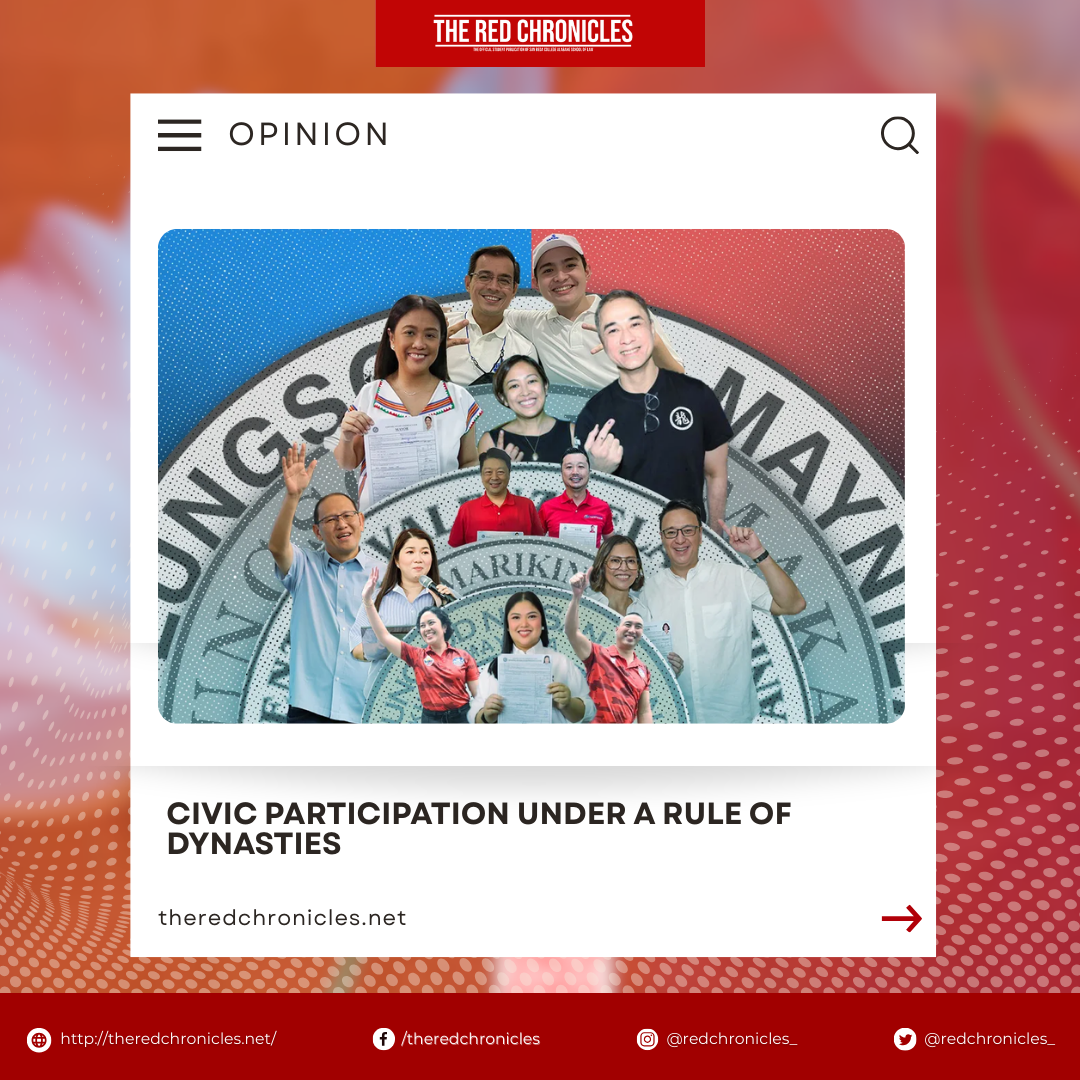
by Alyanna Joyce S. Abadejos | Photo Courtesy: Rappler
Political families — whether revered or reviled — have become so deeply woven into the fabric of our political life that their presence feels almost permanent. For decades, they have mastered the art of winning elections and clinging to power, embedding themselves in positions of authority from the national stage to the smallest of barangays. Currently, it is nearly impossible to imagine a Philippines untouched by their influence, especially as their numbers continue to swell with every election.
While the proliferation of political dynasties in the Philippines is far from novel, what is more concerning is how these mechanisms gradually, yet steadily, encroach upon the roots of civic engagement. Over time, they may reinforce a dependency culture in which citizens become passive and politically disenfranchised actors, ultimately diminishing the strength of political participation — one of the most critical elements of a democratic state.
The 1987 Constitution itself acknowledges the problem, expressly mandating the State to prohibit political dynasties “as may be defined by law.” Yet this provision remains largely ineffective because Congress — often composed of members from political families — has been reluctant to pass the enabling law that would limit their own power. Constitutional recognition exists, but enforcement remains unlikely.
Supporters of political families argue that dynastic politicians may be beneficial because they are “trained from the beginning”— as though having relatives in public office automatically equips them with greater competence, efficiency, and familiarity in the intricacies of public service. Early exposure and built-in mentors, they claim, provide a unique advantage.
Just as easily, this very same advantage becomes a double-edged sword. Family ties can create an uneven playing field in campaigning, elections, and governance. Once a family gains a foothold in political office, the tendency is to expand their influence — from father to son, from husband to wife, and onward — accumulating positions across different levels of government. To maintain power, they can centralize resources and use them to secure public loyalty. Over time, citizens become less inclined to mobilize politically, weakening civic consciousness and reducing accountability.
Regardless of whether these claims for or against political dynasties hold absolute truth, what matters more is a return to one of the most fundamental provisions of the Constitution – “Sovereignty resides in the people and all government authority emanates from them.”
Government authority flows from the people. Citizens must be able to demand that public officers perform their duties with competence, accountability, and integrity. In line with such, a civic movement that understands the meaning of the Constitution and upholds its principles can bolster the future of democracy.
Public officials wield power only because the people have entrusted it to them.
Ultimately, true power continues to reside in the sovereign Filipino people. In the same way, it is the Filipinos themselves who have the power to shape the country’s path forward.
