
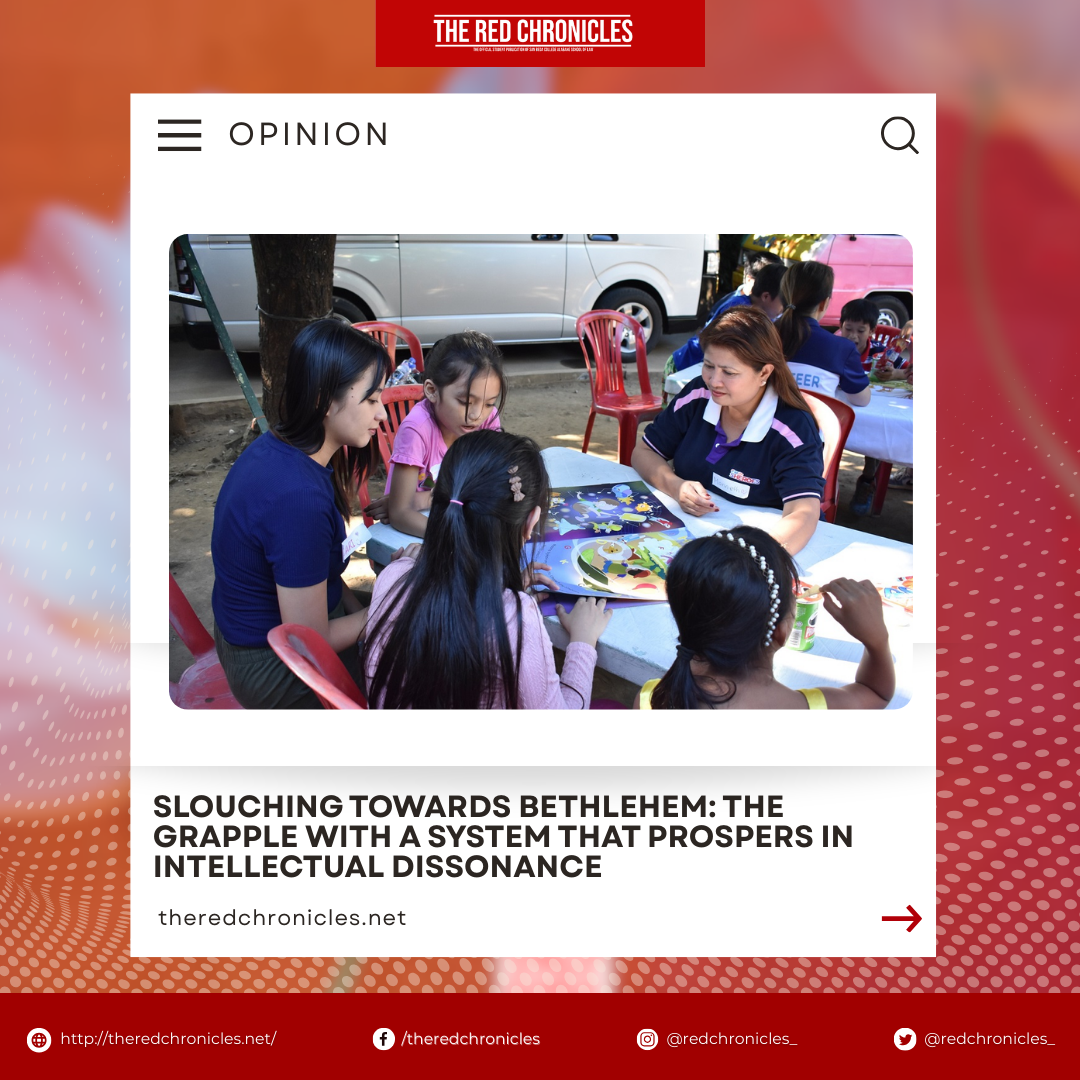
By Leigh Anne Darlene E. Dispo | Photo Courtesy: Child Hope Philippines
Intellectual discourse very rarely favors the right people. When all it is meant to promote is collective action, there is no actual struggle — there is only a fantasy, and the supposed intellectuals of our time who dip their toes into it, weighing its importance in between their hands that have never once labored and toiled under an oppressive system, ought to be held accountable.
Imagine a scene of well-mannered and eloquent educators amidst a discussion that may or may not be so important and meaningful, but their gestures suggest an air of deliberate sophistication. Their words are scholarly, informed, and by-the-book — they are clearly primed up about the debate. It is a sight you would want to be part of, a glimpse into a conversation you would want to be heard in.
Now, imagine the alternative: A group of people in the streets — their words loud, their faces harsh, and their gazes accentuated by something a little less about patience but a more deep-seated resentment that cannot quite be tamed. Some might be illiterate, culturally out-of-touch, and not well-versed in the arena of the higher arts (these days, though, the petty bourgeoisie have participated, albeit rather performative in their sentiments).
Evidently, the first sight is inviting and highbrow; the second one, however, might seem more devil-may-care and mettlesome. But these two examples in mind beg the question: If wanting change is the first step to challenging the status quo, how should the picture look? Is it polished and pedantic? Or is it brazen and insolent?
What is the fine line between the socioeconomic overhaul that benefits the chosen ones and the more profound and political dialogue that leads many overworked, underpaid, and unrecognized working class outside, staggering through the humidity and bracing themselves against police brutality and the world’s better judgment?
The emergence of echo chambers is apparent in real-life situations. Social media sites frequently display news feeds that are predominantly filled with items shared by friends and connections who have similar ideas (Khairunissa et al., 2024). This can lead to the formation of an illusory consensus, when people are exposed to viewpoints that align with their own (X. Wang et al., 2020).
Perhaps the answer is not so crystal clear. The fight for change has no clear-cut path or established routine, but what is unmistakable is there comes a time when the masses have had enough. Echo chambers have the potential to intensify social and political polarization (Khairunissa et al., 2024). Students who are incessantly exposed to information that merely reinforces their preexisting ideas gravitate less or do not empathize at all when faced with opposing perspectives. This, then, results in animosity and a deterioration in the quality of public discussion that can manifest poorly in real-world applications.
The melodramatic middle class posit rhetorical questions on social media (cue the enduring ‘If not now, when?’ schmaltz), but would eventually go back to their mundane and educated ways; whereas the poor’s fight against the system does not lapse. Echo chambers engender a comparable dynamic, creating hostility between conflicting beliefs (Khairunissa et al., 2024).
Weaponized elitism is not a new phenomenon, however, when it comes to the shackles that the oppressed yearn to dismantle. Call it weaponized because it is 1) a mere academic overindulgence for the sake of superficial social awareness and 2) confined among individuals who can safely retreat to the comforts of their privileged bubble. Of all the curated misfortunes and disillusionment that those in power have unleashed upon the poor, the spiritless disposition underlying the supposed progressive discourse of those in the academe is perhaps the worst kind — because it is convenient and safe. Out of harm’s way and business appropriate, so to speak.
Although positive relationships have been found between initiating volunteerism and education, income, parental involvement in volunteering and religious affiliation (Penner, Dovidio, Piliavin, & Schroeder, 2005), as well as empathy and expectancy of success (Wilson, 2000),
Previous studies have found that both initiation of and persistence in volunteering are connected to the importance a person places on an organization’s mission, sense of belonging within the organization and feelings that their contribution matters in advancing the organization’s goals (Clary and Snyder, 1999, Flanagan, 2013, Omoto et al., 2010).
So perhaps the real picture is an omen: It is not the working class finally attaining the political shift and economic reform they have long demanded for, but rather the staggering silhouette of the youth, their backs slouched from academic pressure and ministerial contempt. And their voices no longer mirror those who matter; they instead echo aimlessly against the hollow walls of this belief system we have all been complacent in. There is neither a political transformation across the horizon nor a changing landscape blossoming for the future.
There is no resistance — unless we rewrite the story.
*Apologies to W. B. Yeats
REFERENCES
Khairunissa, T., Purnomo, E.K., Putri, S. D. G. (2024).
Echo Chambers and Algorithmic Bias: The Homogenization
of Online Culture in a Smart Society. SHS Web of Conferences 202.
Penner, L. A., Dovidio, J. F., Piliavin, J. A., & Schroeder, D. A. (2005).
Prosocial behavior: Multilevel perspectives.
Annual Review of Psychology, 56, 365–392.
Wang, X., Sirianni, A. D., Tang, S., Zheng, Z., & Fu, F. (2020).
Public discourse and social network echo chambers driven
by socio-cognitive biases. Physical Review X, 10(4), 41042.
Wilson, J. (2000). Volunteering. Annual Review of Sociology, 26, 215–240.
