
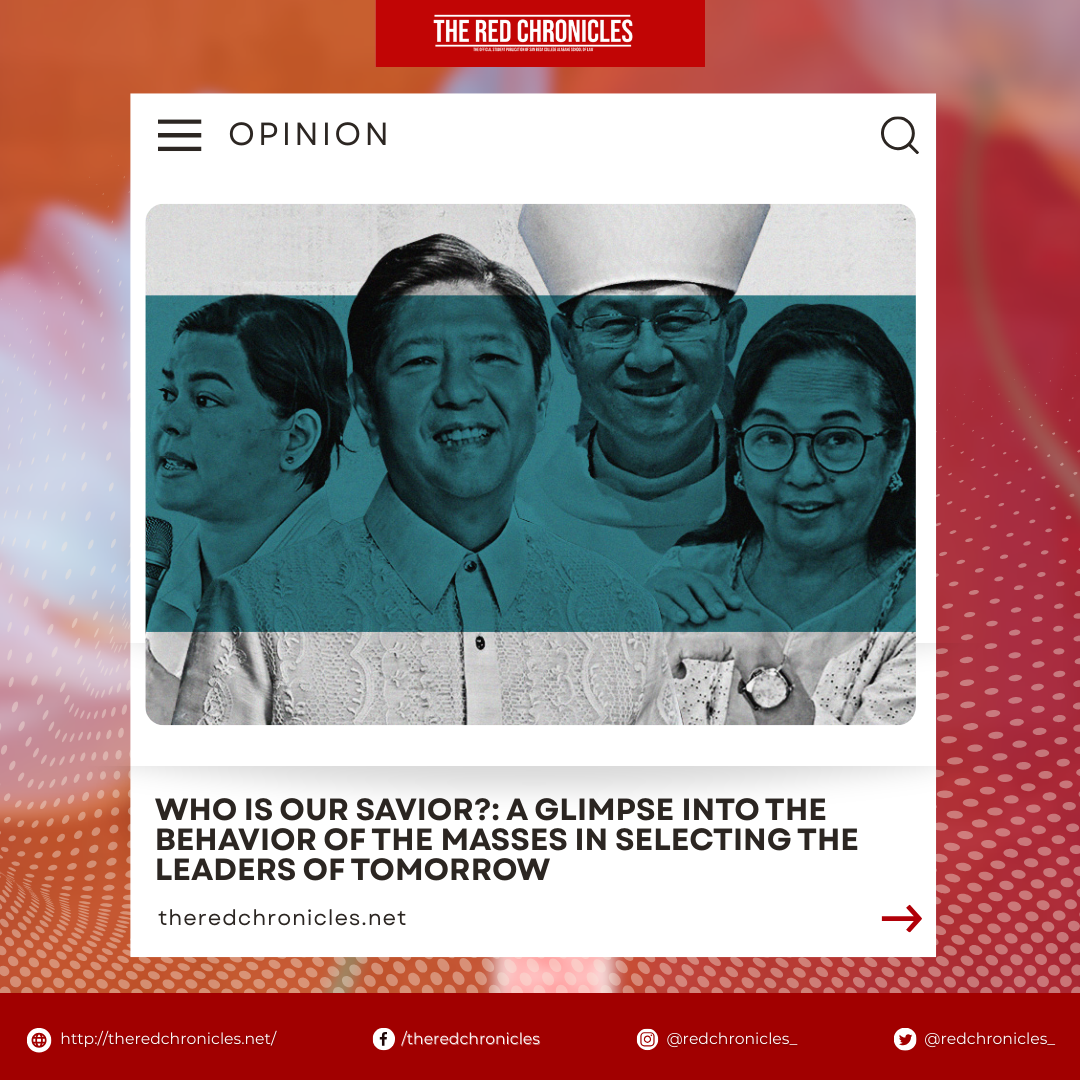
By Carlo Miguel C. Candelaria | Photo Courtesy: Esquire Philippines
Every election period, one individual steps up, making promises of lifting the Filipino people up from their problems. Today, the country still struggles to honor its ever-growing debt, alongside other problems. Multiple leaders promised immediate and significant change for the better, but have fallen short. So the question is: who will save us from this torment?
A recent study done by Emmanuel Paciano Mabulay analyzed the behavior of the voting masses in the past two administrations: Aquino and Duterte. He pointed out that “Voters have shown a tendency to consider candidates who share their qualities or have a track record of addressing certain concerns, even if party affiliation and pre-election polls don’t ensure a candidate’s eligibility or ability.” Furthermore, Mabulay cited the rational choice theory, wherein “someone voting in their best interest, supporting the candidate whose platform will give them the most favorable outcomes”
In addition, our natural tendency towards looking for an authority figure ties in with our Catholicism, wherein we are most accustomed to believing and worshipping God as the bringer of salvation.
Bearing all of these in mind, my conclusion about the behavior of the voters is summarized in one statement: we treat these candidates like prophets.
We prioritize charisma, the delivery of promises. The voters want change in the form of spectacle: tangible and real. This is why campaigns are valued more than debates; why name-recall is often triumphant over credentials. Even though we had promising candidates like Jose Manuel Tadeo “Chel” Icasiano Diokno, or Miriam Defensor-Santiago, run for elections before, the more charismatic candidate will triumph over the capable one.
Also, we believe in the concept of destiny. The voting masses want a good story to get behind. The last administration, the Duterte Administration, became controversial for the radicalization of politics. His firm approach in handling peace and order became subject to scrutiny in the international sphere, all in the name of immediate change.
In Patricia Evangelista’s Some People Need Killing, it narrated different perspectives of voters who supported the Duterte campaign. Some voters called him “Father” or “The Punisher”, reserving their vote on his crude but radical approach in his leadership. They believed that his governance in Davao would translate on the national scale. Projects such as the War on Drugs, and the Build, Build, Build project led his administration.
Another narrative that made a candidate win, was President Benigno Aquino III’s election campaign, which was boosted by then President Corazon Aquino’s death. Even in Ferdinand “BongBong” Marcos Jr.’s campaign, the supposed success of his father, aided his story of redemption in our politics. In both of these campaigns, supporters would refer to their lives then as the “good ol’ days.”
Hence, I would call this spectacle a conversion of politics, akin to one’s conversion to a religion. In choosing our candidates, we follow them like believers to a prophet.
