
By Joanne B. Benitez | The Red Chronicles
Layout by Jed Paul O. Naval | The Red Chronicles
In a democratic society founded on the principle of equality before the law, we are confronted with an unsettling reality: the scales of justice increasingly favor those who have power and privilege.
As law students, we are taught that the law is supposed to be blind. That justice is blind. That it is for everyone, irrespective of class, status, or power. But as we progress deeper into our study of law—and witness the world beyond the classroom—those ideals begin to erode under the weight of reality.
Let us just take as an example the controversial case in January 2022 regarding the “Mango Thief”, an 84-year-old man named Narding “Lolo Narding” Floro. Lolo Narding allegedly took 10 kilos of mangoes from a neighbor’s lot, which he thought was part of their property. He was then arrested on a theft complaint and thereafter detained.
Meanwhile, in November 2018, the Sandiganbayan ruled that former first lady Imelda Marcos, who was convicted of graft on seven counts, could enjoy freedom while appealing her conviction. Marcos was found guilty of having financial interests and participation in the management of private foundations in Switzerland when she served as a Cabinet official during her late husband’s term.
Imprisonment was severe as punishment for an 84-year-old man who took 10 kilos of mangoes from a neighbor’s lot, while VIPs like Imelda Marcos evaded detention even when already convicted.
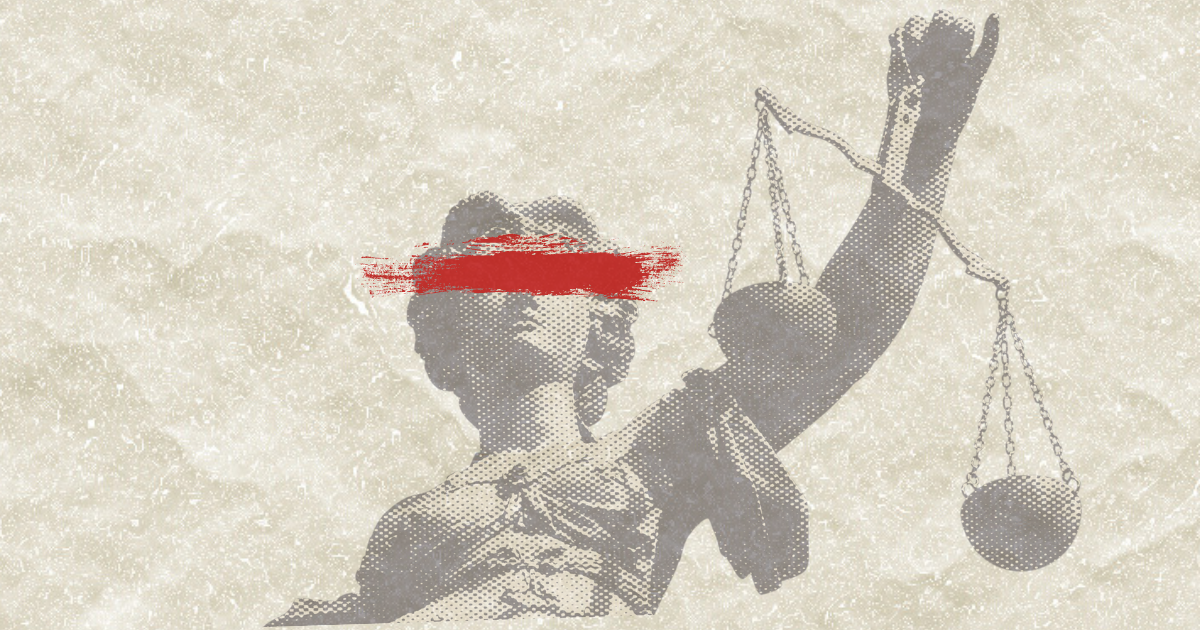
Is justice truly blind—or just conveniently blindfolded?
A hard pill to swallow, but justice in our country too often leans toward those who can pay. While ordinary people rot in prisons for minor thievery or non-violent crimes, the influential regularly walk, protected by influence, loopholes, or sheer postponement. We have witnessed politicians acquitted on the basis of legal technicalities. We have observed rich defendants escaping detention by way of special treatment or lengthy proceedings.
This is not just a defect in individual cases—it is an indication of a deeper systemic imbalance.
Even the very laws we learn, revere, and one day aspire to practice can be—and have been—weaponized. Anti-Terror Law, cyber libel acts, and sedition charges have been used not only for public safety but also sometimes to quash dissent. Legal processes designed to promote justice are warped into vehicles for silencing critics. What does it indicate about our system when speaking truth to power puts an individual at higher risk than perpetrating an actual crime?
As law students, we stand at a crossroads. We are future lawyers, judges, and legislators. We are also citizens—witnesses to injustice, and bearers of privilege and responsibility. And if we do nothing, whom are we serving? And if we do nothing to challenge the biases of the system, are we not perpetuating them?
The law was never designed to be a fortress for the privileged few. It is a bridge—for justice to reach the many. That bridge is, however, crumbling. And if we do not recognize the cracks, we shall allow the whole structure to collapse into obscurity.
Now more than ever, we need to take back the law for the people. That is, use our voices, even when it is uncomfortable. That is, standing up for the marginalized, even when it is unpopular. And that is, holding the system accountable—even when it means holding ourselves accountable as well.
Justice cannot simply be a topic for lectures. It must be our shared belief.
NOTE TO THE READERS: Volume XVIII, Issue 2, penned and published by The Red Chronicles, is a Back Issue for the Publication Year 2024-2025. Note that this article aligns with the events relevant to the previous Academic Year 2024-2025. For further viewing of the same, you may view the flipbook version or visit our official website at theredchronicles.net.
