
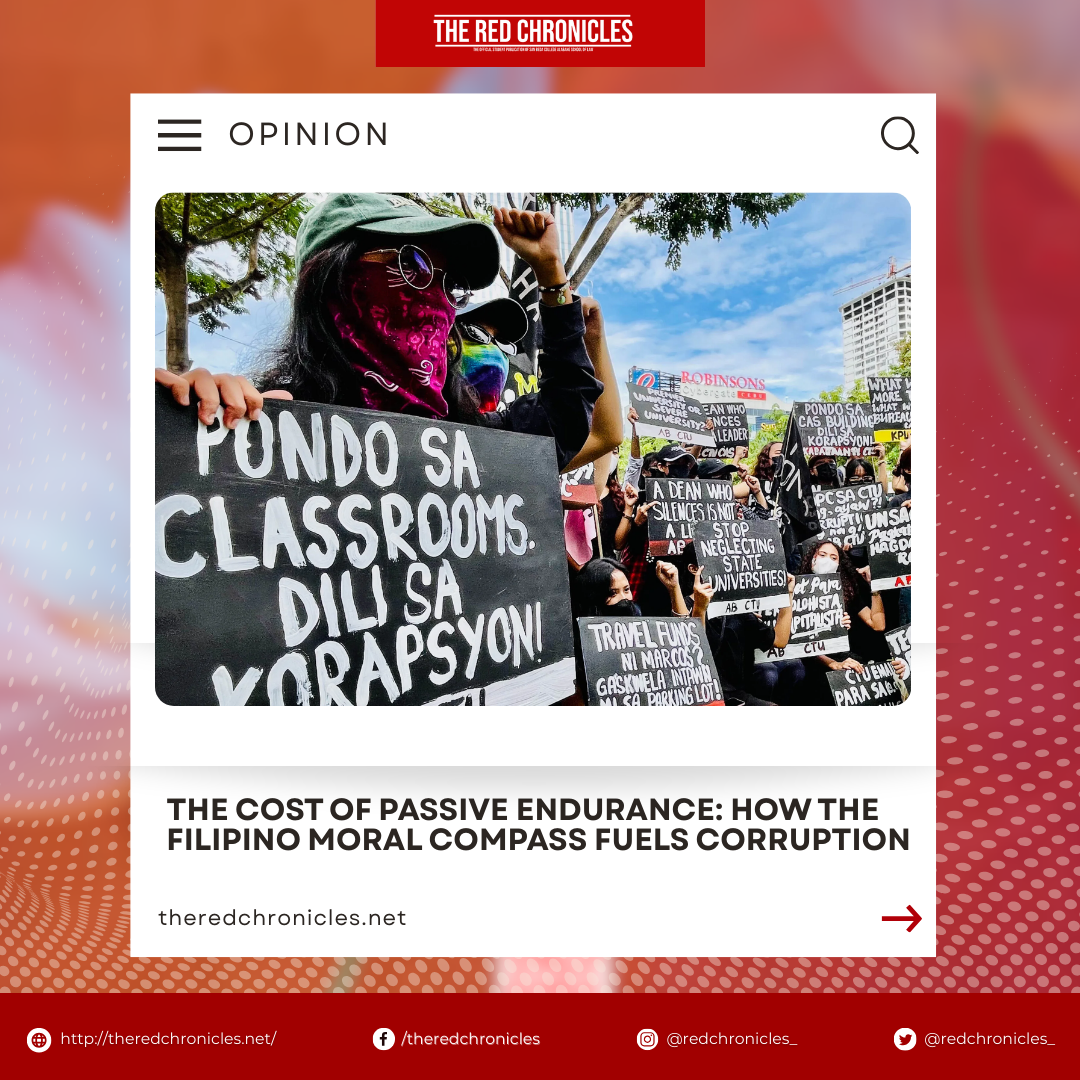
By Lou Margaret Nebit | Photo Courtesy: Rappler
The Philippines prides itself on being a deeply religious nation. From fiestas to family rituals, faith is woven into the country’s cultural fabric. But beyond these colorful displays of devotion lies a more complicated reality: religion has shaped not only Filipino values but also our politics, often in ways we refuse to scrutinize.
Much of our social behavior can be traced to a moral lens shaped by centuries of religious influence. We celebrate pakikisama, the instinct to avoid conflict and maintain harmony, as if it were an unquestionable virtue. We forgive easily, shy away from confrontation, and discourage dissent in the name of peace.
Who pays the price for this habitual submission? It is often those who cannot afford justice, those placed at a disadvantage, while perpetrators remain unaccountable. Could it be that Filipinos have forgotten to demand accountability, mistaking silence for virtue and forgiveness for moral strength? Instead, many find refuge in their own resilience, becoming martyrs to the very suffering they endure, waiting for mercy from the divine to reward their persistence. Unlike neighboring countries, where public outrage can erupt into forceful, collective action, we in the Philippines often retreat into religion and glorify peaceful protests that rarely produce meaningful change.
These traits have helped communities stay close-knit, but they have also conditioned us to equate silence with goodness. In practice, this has produced a population reluctant to question authority, especially when that authority cloaks itself in religious or moral imagery.
This dynamic becomes most visible during elections. Religion in the Philippines is not merely a personal belief; it is a voting force. Bloc voting among certain religious groups has long been an open secret, but its influence extends far beyond formal endorsements. The recent victory of Uniteam illustrates how many Filipinos prioritize unity and harmony over accountability, often mistaking the appearance of peace for true justice. It is no coincidence that candidates often cloak themselves in religious symbolism, knowing full well that spirituality remains a powerful political currency.
The result is a political culture where leaders are treated with the same deference granted to religious figures. We hesitate to challenge them, convinced that criticism disrupts peace and unity. But at what cost?
It is time for the Philippines to move beyond passive endurance and cultural habits that glorify silence, resilience, and polite suffering. Harmony without accountability and forgiveness without justice have allowed corruption to flourish unchallenged. We must choose what is effective, not merely what is traditional, convenient, or comfortable.
We are reminded of Pontius Pilate, who stood at the threshold of moral responsibility yet chose the safer path of convenience. Rather than defend what he knew was just, he washed his hands, both literally and symbolically, and avoided accountability because silence cost him less than courage. His refusal to confront wrongdoing did not make him neutral; it made him complicit. By choosing comfort over conviction, he allowed injustice to triumph unchecked.
In the same way, corruption in the Philippines endures not only because of those who commit it but also because of those who “wash their hands” of the struggle. These are the people who avert their eyes, stay quiet, or convince themselves that nothing can change. When citizens avoid confrontation for the sake of false peace, when we prioritize politeness over principle, we repeat Pilate’s failure. We surrender the nation’s future to the powerful simply because we refuse to intervene.
If we want real transformation, we must be willing to confront the corruptions of our society, those who exploit public trust, manipulate systems, and hide behind authority. Only when we abandon passive suffering and embrace courageous accountability can our nation finally break free from the cycle that has bound it for generations.
